What Is Anxiety? The Survival System Behind Modern Worry
Anxiety is the mind and body preparing for a possible threat. It can show up as worried thoughts, muscle tension, restlessness, a faster heartbeat, difficulty concentrating, stomach discomfort, disrupted sleep, or a sense that something needs your attention right now.
In small or temporary amounts, anxiety can be useful. It may help you notice risk, prepare for an important event, or respond quickly when something is wrong. The difficulty comes when the alarm is intense, frequent, hard to switch off, or out of proportion to what is happening.
If that is familiar, it is not a character flaw. It is a protective system working hard—sometimes harder or longer than the moment requires.
Why do humans feel anxiety?
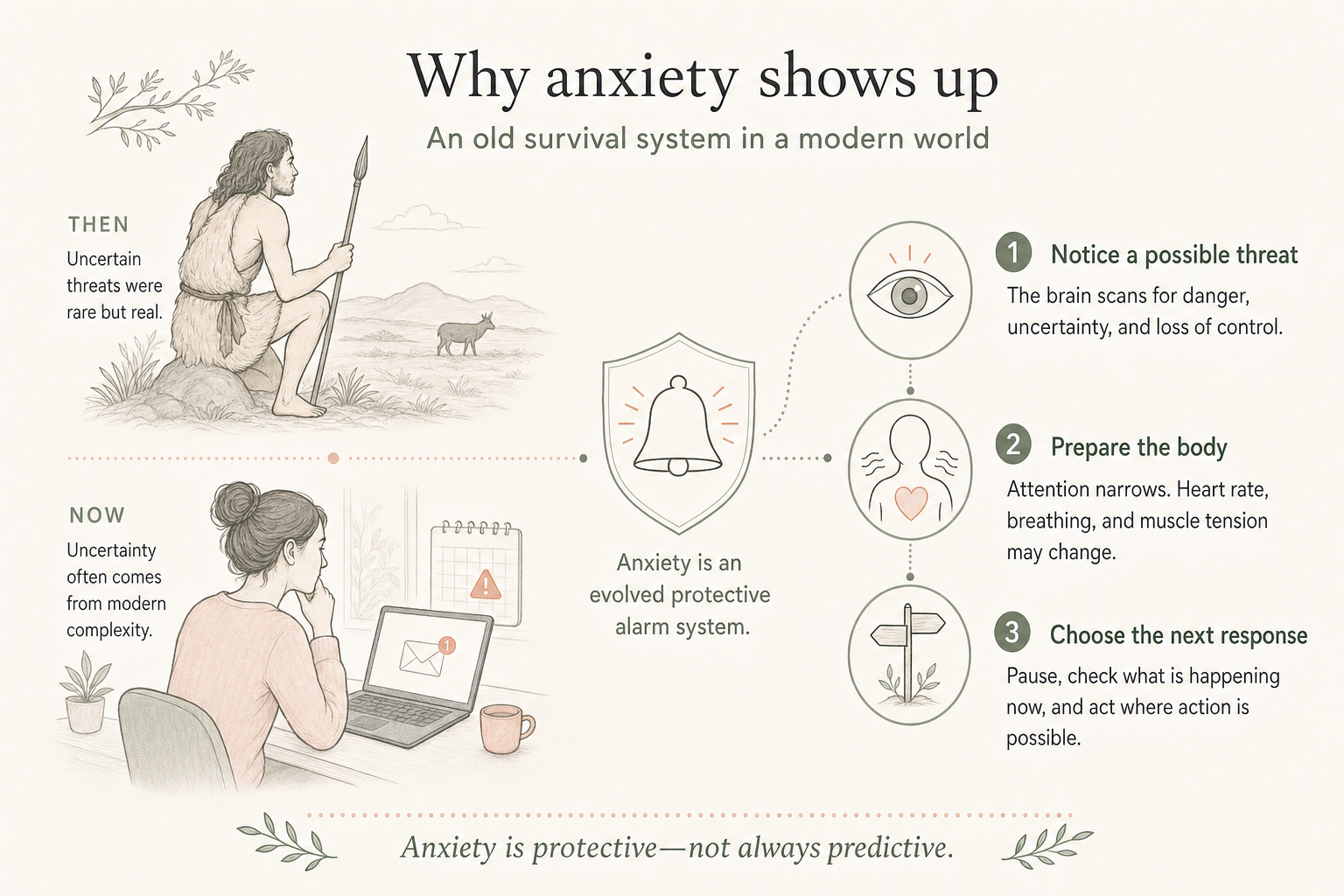
Humans evolved in environments where noticing possible danger quickly could support survival. A rustle in the grass, a separation from the group, a shortage of resources, or signs of conflict could matter. Waiting for complete certainty might have been costly, so the threat system became good at acting on partial information.
That basic pattern is still present. When the brain detects possible danger, it coordinates changes across attention, emotion, and the body. Attention may narrow toward threat. The sympathetic nervous system can prepare the body for action. Stress hormones and changes in breathing, heart rate, digestion, and muscle tension may follow.
This response is often summarized as “fight or flight,” although people may also freeze, become highly compliant, withdraw, or feel mentally blank. No single phrase captures every nervous-system response.
An ancient alarm in a modern environment
For our ancestors, many threats were concrete and time-limited. Modern anxiety is often activated by situations with no clear finish line:
- waiting for medical information;
- wondering what someone thinks of you;
- job instability or a difficult deadline;
- financial uncertainty;
- repeated exposure to distressing news;
- a future decision with no guaranteed outcome.
The body can respond to these uncertainties even when there is no immediate physical danger. The mind tries to close the gap by predicting, rehearsing, checking, and planning. Sometimes that creates a useful action. Sometimes it becomes worry: repetitive thinking about possible negative outcomes without a satisfying resolution.
Anxiety is real even when the danger is uncertain. The sensations are not “all in your head.” At the same time, a real alarm does not always mean there is a present emergency.
Anxiety, stress, and generalized anxiety disorder
People often use stress and anxiety interchangeably. Stress usually refers to a response to an identifiable demand, such as an illness, conflict, or deadline. Anxiety can continue even when the source is unclear or the immediate demand has passed.
Generalized anxiety disorder, or GAD, involves excessive anxiety and worry across multiple areas of life that is difficult to control and causes meaningful distress or impairment. Diagnosis belongs to a qualified clinician; an online article or wellness app cannot determine whether someone has GAD.
Consider speaking with a licensed mental health professional if worry feels persistent, is affecting sleep or concentration, leads you to avoid important parts of life, or is interfering with work, relationships, or daily functioning. Effective treatment is available.
What keeps worry going?
Worry can feel like preparation. It may create a temporary sense that you are doing something about uncertainty. The mind can also learn that repeated checking, reassurance, avoidance, or mental rehearsal reduces discomfort for a moment.
That short-term relief can strengthen the cycle:
- A thought, sensation, or situation triggers uncertainty.
- The mind predicts danger.
- The body becomes more alert.
- You worry, check, avoid, or seek certainty.
- Discomfort drops briefly.
- The mind learns that the safety behavior was necessary.
Understanding this cycle is not an invitation to blame yourself. It is a map. Maps make new responses possible.
A gentle first response to anxiety
When anxiety appears, try three steps:
1. Name what is happening
Use plain, nonjudgmental language: “I am noticing anxiety,” or “My threat system is active.” This can create a small amount of distance from the conclusion that something terrible must be happening.
2. Check the present moment
Ask: “Is there an immediate danger I need to respond to?” If yes, take the practical safety step. If not, notice what is physically supporting you—the chair, the floor, the room—and let your breathing remain easy.
3. Decide when this thought needs attention
If there is a useful action you can take now, name the smallest one. If the worry does not need an immediate response, save it for a chosen appointment time. You can say: “This matters, and I do not have to solve it in this minute.”
Frequently asked questions
Is anxiety always bad?
No. Anxiety is a normal human response and can support preparation and safety. It becomes a concern when it is excessive, persistent, difficult to control, or disruptive.
Why do I feel anxious when nothing is wrong?
The threat system responds to possibility, memory, bodily sensations, and uncertainty—not only to confirmed danger. A clinician can also help rule out medical conditions or substances that may contribute to anxiety symptoms.
Can I make anxiety disappear?
Trying to eliminate every anxious feeling can become another struggle. Many evidence-based approaches focus instead on changing how you respond: increasing tolerance for uncertainty, reducing avoidance, working with thoughts and body arousal, and taking meaningful action even when some anxiety is present.
The takeaway
Anxiety is a protective system, not a personal failure. In a world filled with open-ended uncertainty, that system can stay active long after urgent action is useful. The aim is not to silence it by force. It is to learn when the alarm carries actionable information, when it is asking for impossible certainty, and how to respond with more choice.
Appointment With My Anxiety is a self-guided wellness tool, not a diagnostic or treatment service. If anxiety is distressing or disrupting daily life, seek support from a qualified mental health professional.