How to Build a Sustainable Daily Practice for Anxiety
Anxiety can turn helpful practices into performance tests: Did I do it every day? Did I feel calmer? Did I do it correctly? A sustainable routine begins by refusing that frame.
The purpose of a daily anxiety practice is not to earn a perfect mood. It is to create repeated moments of choice—moments when you can notice what is happening, decide what needs action, and respond with care.
What progress can look like
Reduced symptom intensity may be one sign of progress, but it is not the only one. You may notice:
- recognizing a worry earlier;
- delaying repeated checking or reassurance;
- returning to a task while some uncertainty remains;
- taking a practical step more directly;
- using kinder language with yourself;
- recovering more quickly after a difficult moment;
- asking for professional support sooner.
These shifts matter even when anxiety still appears.
The five parts of a balanced practice
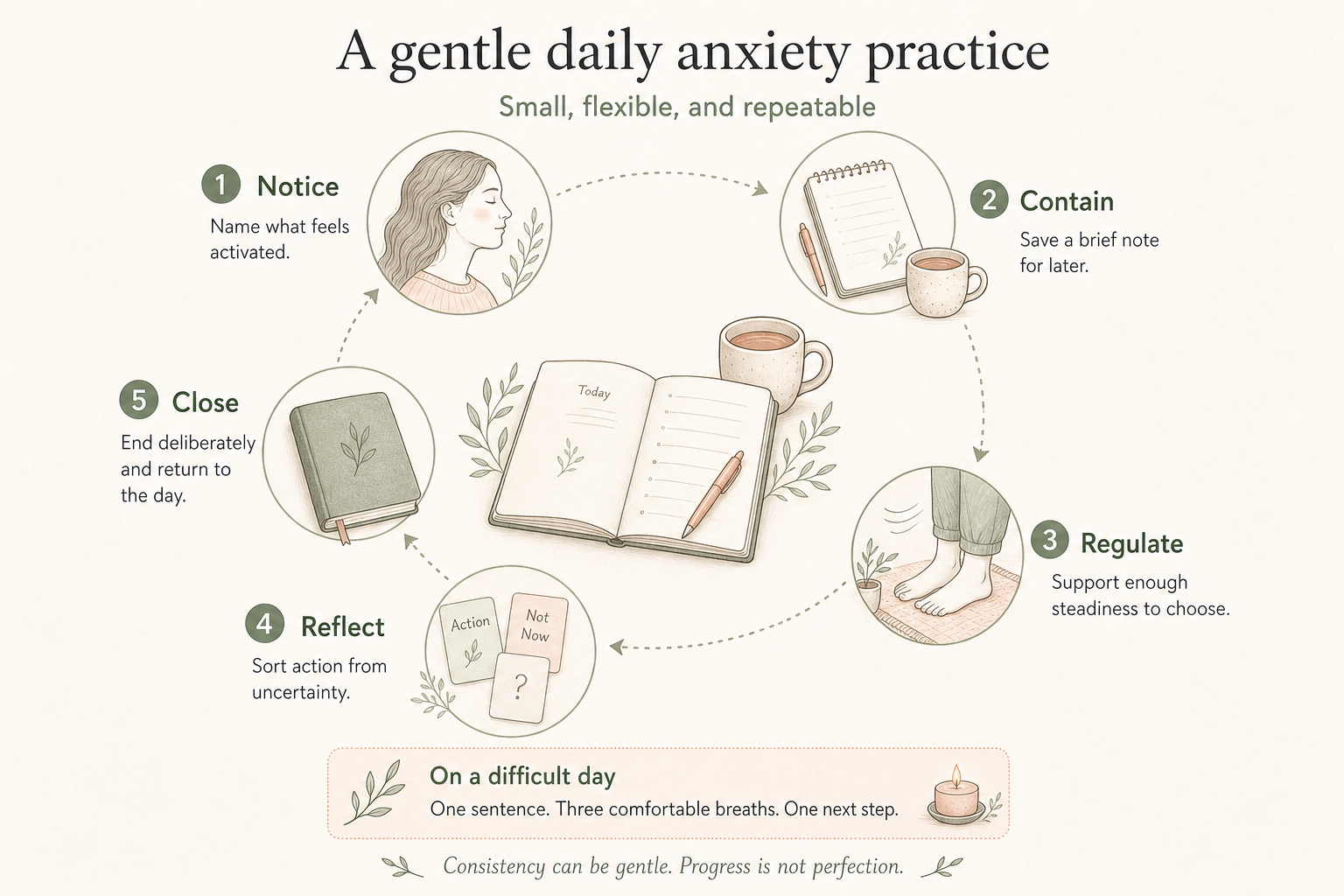
1. Notice
Pause long enough to name the experience: worry, tension, urgency, fear, irritability, or uncertainty. You do not need a perfect label. “Something feels activated” is enough.
2. Contain
If the concern does not require immediate action, save a brief text or voice note for your chosen appointment. Capturing the thought can reduce the need to rehearse it so you will not forget.
3. Regulate
Use a body-based skill that feels safe: a slow comfortable breath, feeling both feet, looking around the room, stretching, or stepping outside. Regulation does not mean forcing calm; it means supporting enough steadiness to choose your response.
4. Reflect
At your appointment, sort actionable concerns from hypothetical worry. Create a next step where one exists. For uncertainty that cannot be solved, write a balanced statement and practice leaving the question open.
5. Close
End the appointment deliberately. A timer, closing phrase, brief movement, or sensory grounding can help. Do not wait until every worry feels resolved; many cannot be resolved today.
How often should you schedule worry time?
Daily practice can help establish the pattern, especially at the beginning, but “daily” should not become rigid. Some people use an appointment on weekdays, several times a week, or only during more anxious periods.
Start with 10 to 20 minutes. Shorten the appointment if it turns into rumination. End early when nothing needs attention. The container exists for you; you do not exist to fill the container.
Use minimum versions for difficult days
A minimum version keeps the practice accessible:
- one sentence instead of a page;
- one saved thought instead of processing the full list;
- three comfortable breaths instead of a timed exercise;
- one next action instead of a complete plan;
- a five-minute appointment instead of twenty.
Reducing the size of a practice is often more sustainable than abandoning it because the ideal version is unavailable.
Review patterns without turning them into grades
Once a week, ask:
- What themes keep appearing?
- Which worries became practical steps?
- Which worries asked for impossible certainty?
- Which skills felt supportive?
- What made the practice harder to use?
- What is one small adjustment for next week?
Progress tracking should provide information, not judgment. A streak can be encouraging for one person and pressuring for another. Use it only if it supports the intended relationship with the practice.
When self-help is not enough
A routine may be useful alongside professional care, but it should not become a reason to delay it. Consider reaching out to a licensed clinician when anxiety is persistent, escalating, or interfering with sleep, health, work, school, relationships, or daily responsibilities.
Seek urgent help if you are at risk of harming yourself or someone else, cannot keep yourself safe, or are experiencing a medical emergency. Use local emergency services or a crisis resource available in your country.
Evidence-based treatment for generalized anxiety disorder may include cognitive behavioral therapy, acceptance-based approaches, medication, or a combination tailored to the individual. Asking for help is not a failure to self-regulate; it is a form of effective action.
A realistic weekly rhythm
Monday–Friday: Save worries as they arise; hold a short appointment at the chosen time.
Saturday: Use the appointment only if it feels useful.
Sunday: Review patterns and adjust the week ahead.
Or choose a completely different rhythm. The best structure is the one you can use without it becoming another source of fear or self-criticism.
The takeaway
A sustainable anxiety practice is flexible, bounded, and compassionate. It helps you notice the alarm without obeying every demand, act where action is possible, and make room for uncertainty where certainty is not. Progress is not a life without anxiety. It is a growing ability to meet anxiety with more choice.
Appointment With My Anxiety is a self-guided wellness tool and does not replace diagnosis or treatment from a qualified professional.