How Scheduled Worry Time Can Help You Contain Anxious Thoughts
When worry arrives, it rarely asks whether this is a good time. It interrupts the meeting, the commute, the conversation, or the quiet moment before sleep. Scheduled worry time is a structured practice for acknowledging the thought without giving it the rest of the day.
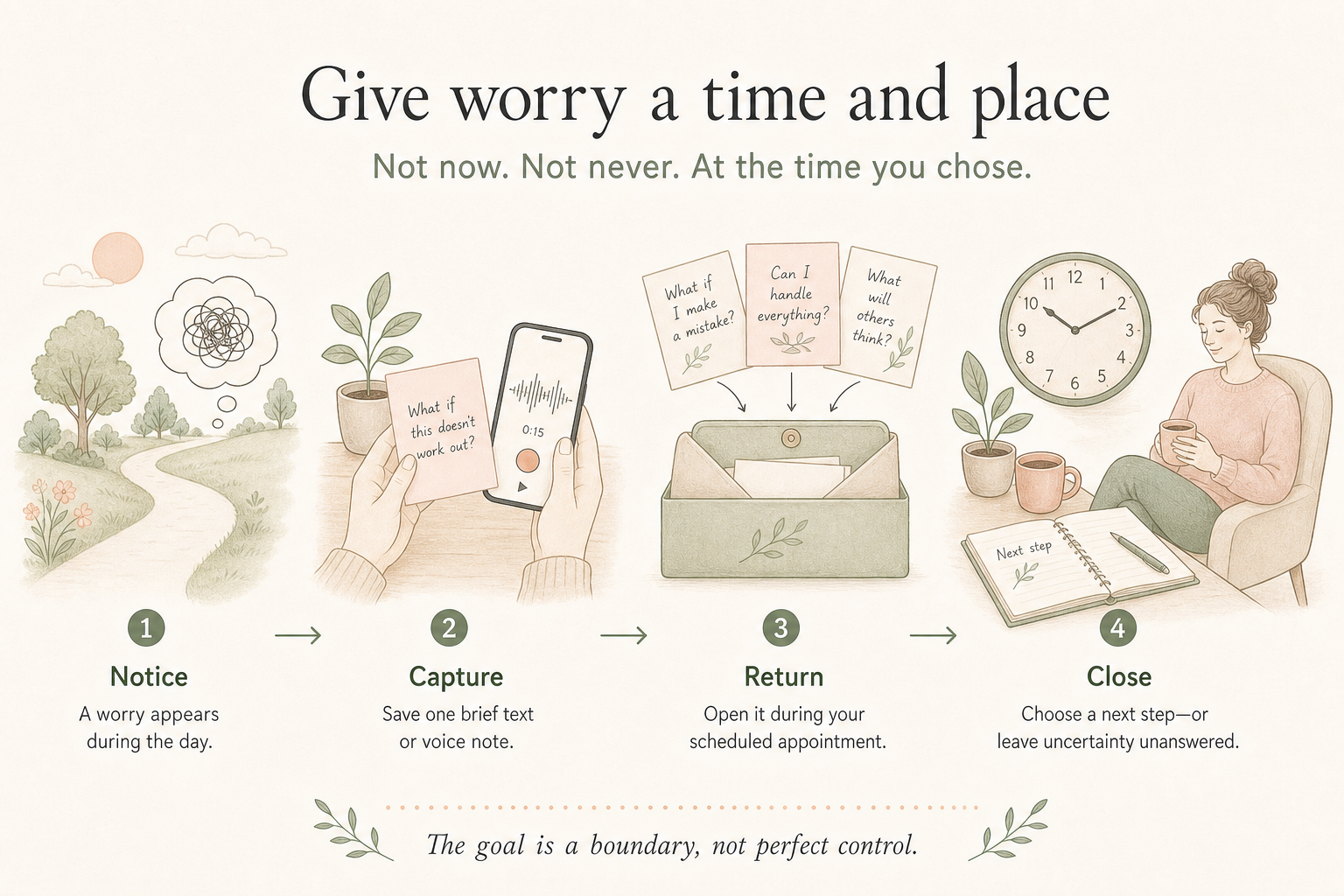
The basic idea is simple: choose a brief, consistent time to engage with worries. When one appears earlier, capture it and return at the scheduled time.
This is not the same as telling yourself to “just stop thinking about it.” The message is more respectful: “I am not ignoring this. I have made a place for it.”
What is scheduled worry time?
Scheduled worry time—also called worry postponement—is a skill used in some cognitive-behavioral and metacognitive approaches. It creates a distinction between noticing a worry and entering a prolonged worry process.
The practice generally has two parts:
- During the day, briefly record the worry and postpone extended engagement.
- At a chosen appointment time, review what you recorded and decide what response is useful.
The goal is not to guarantee fewer thoughts. It is to strengthen your ability to choose when and how you respond.
Why can a “worry container” feel helpful?
Anxious thoughts often carry two messages: the content of the worry and a demand for immediate attention. A container addresses the second message. Saving the worry makes it less necessary to hold every detail in working memory. A planned return can also reduce the fear that postponing means forgetting or being irresponsible.
Over time, you may notice that some saved worries lose intensity before the appointment. Others become clearer. Some still feel important and deserve attention. The container does not decide for you; it gives you a calmer context in which to decide.
Research findings are not uniform. Worry postponement has shown promise, particularly in nonclinical samples and within broader treatment approaches, while stand-alone results for clinical GAD have been mixed. It is best understood as a practical skill rather than a cure.
How to schedule an appointment with your anxiety
Choose a workable time
Start with 10 to 20 minutes at a time you can usually protect. Late afternoon or early evening works for many people. If possible, avoid placing the appointment directly before bed, when increased mental activation may interfere with sleep.
Consistency helps, but rigidity does not. Choose a time that fits your actual life.
Pick a place
Use a reasonably quiet, neutral place. Sitting upright at a desk or table can create a helpful boundary. If worry is strongly associated with bed, keep the practice elsewhere.
Capture, do not elaborate
During the day, write or record enough to remember the concern without beginning a full analysis. For example:
- “Presentation: afraid I will freeze.”
- “Dad’s appointment results.”
- “Did that message sound rude?”
Then note the return time: “I will come back to this at 6:00.”
Redirect gently
Return attention to a concrete sensory or behavioral anchor: the sentence you were reading, the dish you were washing, or the next step in your task. The worry may return. Repeating the boundary is part of the practice.
What to do during worry time
Open each note and ask:
- Is this still important to me?
- Is there a present, practical problem?
- If so, what is one realistic next step?
- If not, what uncertainty am I trying to eliminate?
- What would help me close the appointment for today?
Write down actions outside your appointment only when they are specific. “Solve my career” is not an action. “List three questions for my manager by Friday” is.
For hypothetical worries, the work may be acknowledging uncertainty: “I cannot know exactly how this will go. I can prepare for the meeting and respond to what actually happens.”
End on time. Closing the container matters as much as opening it. Stand, stretch, wash your hands, step outside, or name five things you see. A small transition signals that the appointment is complete.
Common difficulties
“The worry keeps coming back.”
That is expected. Success is not the absence of a thought; it is practicing the response again. Use the same brief phrase and redirect without scolding yourself.
“I cannot stop analyzing while I write the note.”
Limit yourself to one sentence or a 20-second voice note. Record the topic, not every argument.
“I have nothing to worry about at my appointment.”
You do not need to generate worry. Review the list, notice what no longer needs attention, and close early.
“Worry time makes me more distressed.”
Shorten the practice, add grounding, or pause it. A therapist can help tailor the skill, especially if worries involve trauma, compulsions, panic, or severe distress.
Is scheduled worry time right for everyone?
No single self-help strategy fits everyone. This practice is not intended for emergencies, immediate safety decisions, or situations that require prompt medical or practical action. It may also need professional adaptation when worry is part of obsessive-compulsive disorder, post-traumatic stress, severe depression, or another condition.
If anxiety is persistent or impairing, seek a clinical assessment. A structured app can support reflection, but it cannot replace individualized care.
The takeaway
Scheduled worry time offers anxiety a respectful boundary: not now, not never, but at a time you have chosen. The practice can help you move from automatic engagement toward deliberate response—one saved thought and one return at a time.