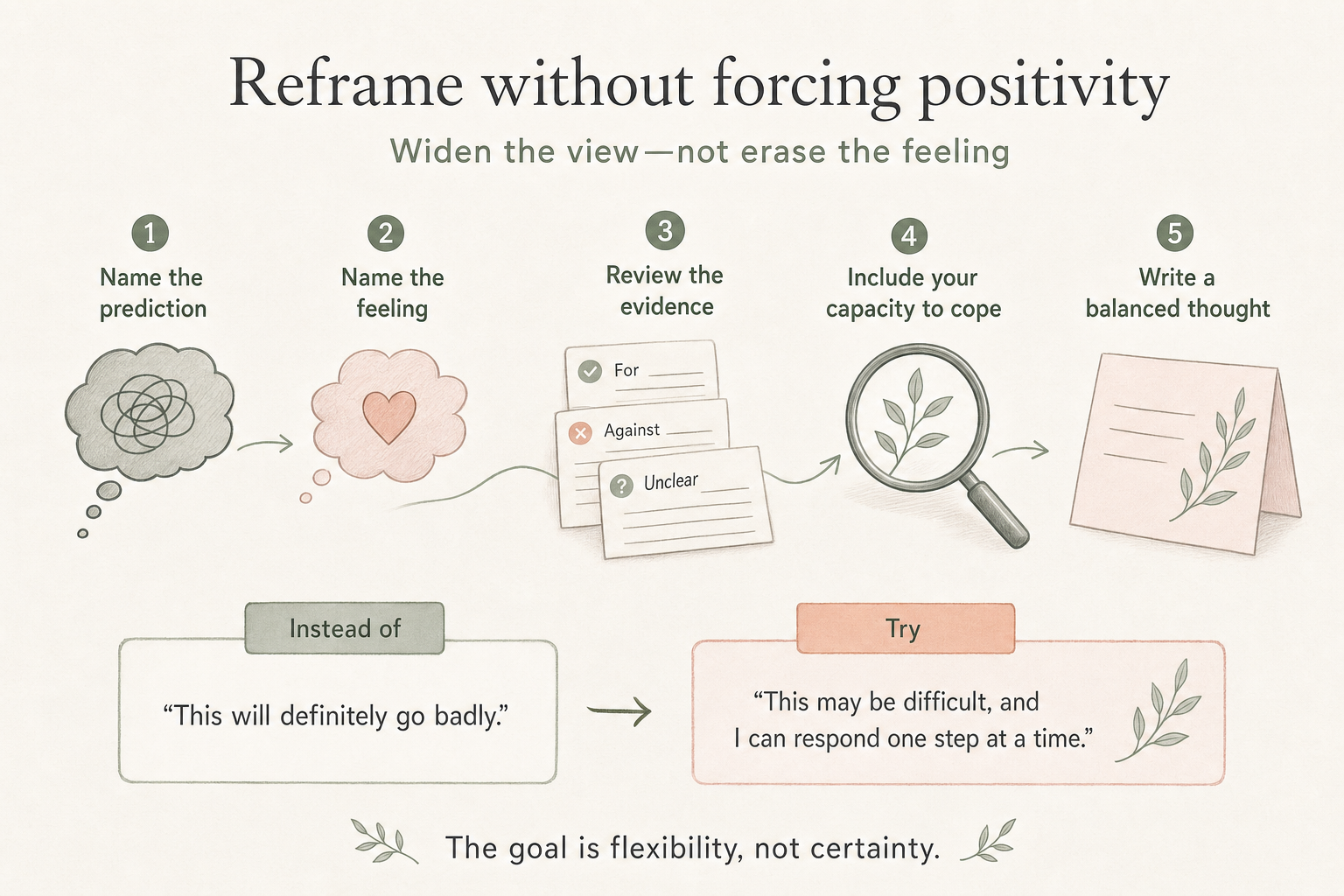
How to Reframe Anxious Thoughts Without Toxic Positivity
Anxious thoughts often sound certain: “This will go badly.” “I will not cope.” “They are upset with me.” Because the body is alarmed, the prediction can feel less like a thought and more like a fact.
Cognitive reframing is a way to examine that prediction and build a more complete perspective. It is not an instruction to think positively. A useful reframe should be accurate enough to believe, compassionate enough to use, and specific enough to guide your next step.
What cognitive reframing is—and is not
Reframing means looking at the same situation through a wider lens. It may involve identifying assumptions, checking evidence, considering other explanations, and remembering coping resources.
It is not:
- insisting that everything will be fine;
- denying genuine risk or pain;
- blaming yourself for having a negative thought;
- trying to debate yourself until anxiety disappears.
The goal is flexibility, not certainty.
Why anxious predictions feel convincing
Anxiety directs attention toward threat. The mind may overestimate the likelihood or cost of a negative outcome, underestimate coping ability, or treat uncertainty as evidence of danger. Memories and bodily sensations that match the fear become easier to notice, while disconfirming information fades into the background.
These patterns are understandable products of an activated threat system. Naming them creates room for another interpretation.
A five-step reframing practice
1. Write the prediction in one sentence
Be specific. “Everything is terrible” is hard to examine. “I am predicting that I will freeze during tomorrow’s presentation and my team will lose confidence in me” is clearer.
2. Name the feeling and its intensity
For example: anxiety 8/10, shame 5/10. Feelings provide important information about your experience, but their intensity does not prove the prediction.
3. Review the evidence fairly
Ask:
- What observable facts support this thought?
- What facts do not fit it?
- What information is missing?
- Am I treating a possibility as a certainty?
Avoid turning this into a courtroom where you must prove the thought false. You are gathering a fuller record.
4. Include your capacity to respond
Anxiety often asks only, “What if it happens?” Add: “If it did, what could help me cope?” Consider skills, people, time, prior experience, professional support, and the ability to make a next decision after new information arrives.
5. Write a balanced alternative
A strong alternative acknowledges both difficulty and capacity.
Prediction: “If I feel anxious, everyone will know I am incompetent.”
Balanced thought: “I may feel anxious, and that does not determine how I perform. I can pause, use my notes, and answer one question at a time.”
Prediction: “They have not replied because I upset them.”
Balanced thought: “I do not know why they have not replied. My mind is filling in the gap with the most threatening explanation. I can wait for more information.”
What makes a reframe believable?
Use language such as:
- “It is possible that…”
- “I do not know yet…”
- “Another explanation is…”
- “Even if this is difficult…”
- “The next step I can take is…”
Avoid absolutes you cannot support. “Nothing bad will happen” asks your mind to accept another guarantee. “I cannot control the outcome, but I can prepare and respond” is more durable.
Reframing real problems
Some fears are grounded in real hardship, discrimination, illness, loss, or instability. Reframing should never erase context or place responsibility on someone to feel differently about an unsafe situation.
In a real problem, the balanced thought may be: “This situation is genuinely difficult. I deserve support. I will focus on the safety step available today.” Accuracy can include anger, grief, and limitation.
When reframing becomes reassurance
Repeatedly rewriting a thought until you feel completely certain can become another anxiety loop. Try one thoughtful reframe, choose any useful action, and then allow discomfort to settle in its own time. The reframe is a guide for behavior, not a ritual that must remove the feeling.
A template for your next anxiety appointment
Situation: What happened?
Prediction: What does anxiety say will happen?
Feeling: What do I feel, and how strongly?
Evidence: What supports the prediction? What does not?
Unknowns: What can I not know right now?
Coping: What could help me respond?
Balanced thought: What is more complete and believable?
Next step: What matters now?
The takeaway
Reframing is not a demand to feel positive. It is an invitation to move from a narrow threat prediction toward a fuller account—one that includes evidence, uncertainty, context, and your capacity to cope. The anxious thought can remain present without having the final word.