Breathwork for Anxiety: How Slow Breathing May Support the Vagus Nerve
When anxiety is active, advice aimed only at thoughts can feel incomplete. The jaw is tight. The chest feels busy. The stomach drops. The body is already participating.
Breathwork is one way to work with that physical layer. It is accessible and can be practiced briefly, but it is often described with more certainty than the research supports. Slow breathing may help regulate arousal; it does not “reset” the nervous system on command, and it is not a cure for anxiety.
How breathing and anxiety interact
Breathing is normally automatic. It changes with activity, speech, illness, emotion, and the environment. Anxiety can make breathing faster, shallower, irregular, or more noticeable. In turn, overbreathing can contribute to sensations such as lightheadedness, tingling, chest discomfort, or air hunger, which may be interpreted as further danger.
Unlike most automatic functions, breathing can also be adjusted deliberately. This makes it a bridge between conscious action and the autonomic nervous system.
What is the autonomic nervous system?
The autonomic nervous system helps regulate processes that do not require constant conscious control, including heart rate, digestion, pupil changes, and aspects of breathing. Its sympathetic branch supports mobilization; its parasympathetic branch supports functions associated with rest, recovery, and conservation.
These are not simple on/off states, and “sympathetic equals bad” is inaccurate. We need mobilization to stand, exercise, focus, and respond to genuine danger. Regulation means flexibility: being able to increase activation when needed and settle when the demand has passed.
What does the vagus nerve have to do with breathing?
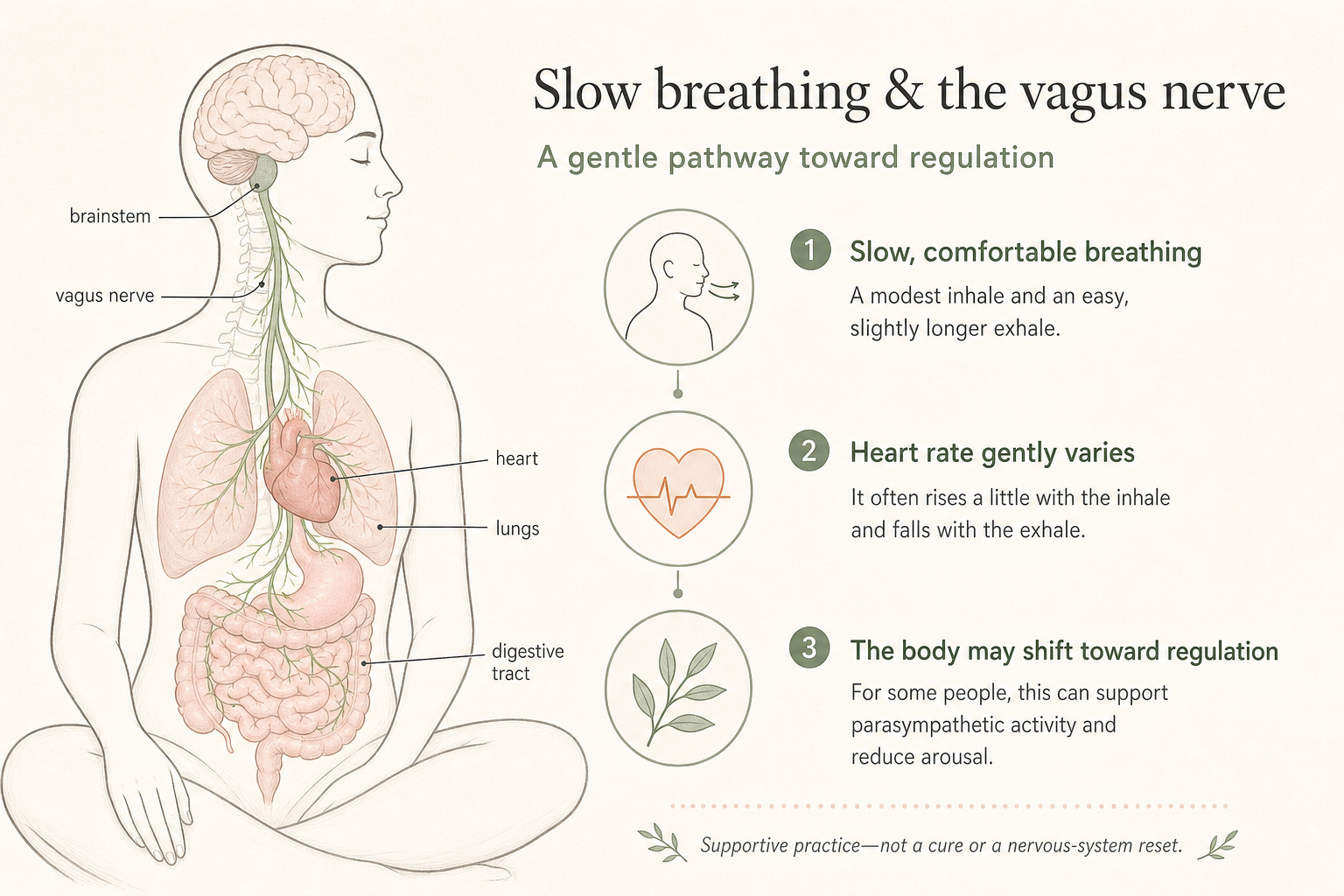
The vagus nerve is a major pathway of the parasympathetic nervous system. It carries signals in both directions between the brain and organs, including the heart, lungs, and digestive tract.
Heart rate naturally changes across the breathing cycle—typically increasing somewhat during inhalation and decreasing during exhalation. This pattern is called respiratory sinus arrhythmia. Slow, comfortable breathing can make these oscillations more pronounced and is often associated with changes in heart-rate variability, or HRV.
HRV describes variation in the time between heartbeats. In many contexts, greater vagally mediated HRV is associated with adaptive regulation, but it is not a simple score of calmness or health. Age, fitness, medication, illness, posture, breathing pattern, and measurement method all matter.
It is reasonable to say that slow breathing may support parasympathetic or vagally mediated regulation. It is less accurate to say that one technique “activates,” “tones,” or “resets” the vagus nerve in a guaranteed way.
What does research say about breathwork for anxiety?
Systematic reviews suggest that voluntary slow-breathing practices can influence cardiovascular and autonomic measures and may reduce stress or anxiety for some people. However, studies vary in breathing rate, session length, guidance, comparison groups, and participant population. Breathwork trials involving people with diagnosed anxiety disorders remain more limited than the wellness claims online might suggest.
The most responsible summary is:
- slow breathing can change physiology in measurable ways;
- some people experience reduced arousal or anxiety;
- effects are not identical for everyone;
- breathwork is a supportive skill, not a stand-alone substitute for evidence-based treatment.
A gentle slow-breathing exercise
Try this for one to three minutes when you are seated and safe.
- Let your shoulders and jaw soften without forcing them.
- Breathe in gently through your nose for about four seconds.
- Breathe out comfortably through your nose or softly pursed lips for about six seconds.
- Let the belly move if that feels natural. Keep the breath quiet and modest rather than taking the biggest breath possible.
- After several cycles, allow your breathing to return to normal and notice what changed, if anything.
The ratio is a guide, not a rule. If four in and six out feels difficult, try three and four, or skip counting. Comfort matters more than achieving a target.
Why “take a deep breath” can backfire
People often interpret “deep” as “large.” Repeated very large breaths can increase overbreathing and make dizziness or tingling worse. A more helpful cue is slow, low, and comfortable. The breath should not feel like a performance.
Some people also become more anxious when focusing inward. Keeping the eyes open, feeling the feet on the floor, or using an external visual pacer may help. It is always acceptable to stop.
Breathwork safety
Stop and return to normal breathing if you feel dizzy, faint, numb, increasingly short of breath, or more distressed. Avoid long breath holds or forceful practices if you are pregnant or have cardiovascular, respiratory, neurological, or other relevant medical conditions unless a clinician has said they are appropriate. Seek medical care for new, severe, or unexplained breathing or chest symptoms rather than assuming they are anxiety.
Breathwork should never be framed as proof that symptoms are harmless.
When to use breathing in an anxiety appointment
Breathing can help at several points:
- Before: as a transition from the day into reflection.
- During: when body arousal is making it hard to think clearly.
- After: as part of closing and returning attention to the present.
Try not to use the breath as a demand to become calm. A better aim is to give the body a steady rhythm while you make room for what is present.
Frequently asked questions
Is a longer exhale always better?
No. A slightly longer, comfortable exhale may feel settling and can influence heart-rate dynamics, but excessively long exhales can cause strain or air hunger. Ease matters more than ratio.
How many breaths per minute should I take?
Many studies of slow breathing use rates below 10 breaths per minute, often near 5–6. There is no universal ideal, and forcing a rate can be counterproductive. Use a comfortable pace or seek professional guidance.
Does breathwork cure generalized anxiety disorder?
No. It may be one supportive regulation skill. Evidence-based care for GAD may include psychotherapy, medication, or both.
The takeaway
Breathing offers a practical way to influence the body side of anxiety. Slow, comfortable breathing may support vagally mediated regulation and reduce arousal for some people. Use it gently, keep claims modest, and let it complement—not replace—the broader work of understanding worry, tolerating uncertainty, and seeking care when needed.