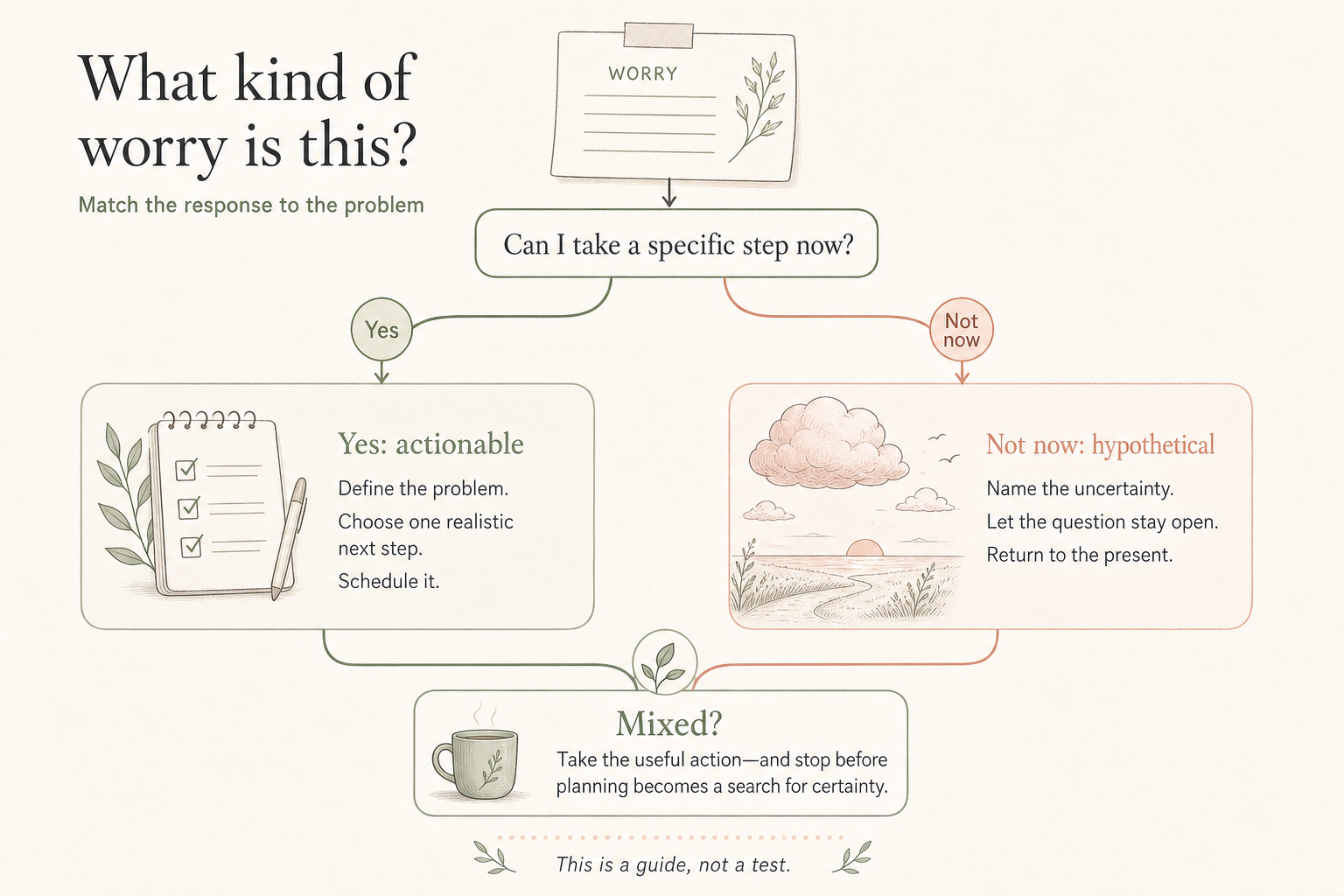
Actionable Problems vs. Hypothetical Worry: How to Tell the Difference
Worry often feels productive because it uses the language of planning. It asks questions, generates scenarios, and searches for risk. But not every worry can become a useful action.
One of the most helpful distinctions is between an actionable problem and a hypothetical worry. Both can feel important. They need different responses.
What is an actionable problem?
An actionable problem is usually current, specific, and within at least some degree of your influence. It can be translated into a concrete next step.
Examples:
- “The rent is due Friday and I have not transferred the money.”
- “I need clarification about the project requirements.”
- “I have had a persistent symptom and need to contact my clinician.”
The action may not solve the entire situation. It simply moves it forward: schedule the payment, send the question, make the appointment.
What is a hypothetical worry?
A hypothetical worry concerns a possible future outcome that cannot be resolved now. It often begins with “what if” and expands when answered.
Examples:
- “What if I say the wrong thing and everyone thinks I am incompetent?”
- “What if my partner’s quiet mood means the relationship is ending?”
- “What if I receive bad news and cannot cope?”
These are understandable fears, but no amount of thinking can guarantee how other people, the future, or your own emotions will behave.
The three-question sorting test
Ask:
- Is the problem happening now, or am I predicting that it might happen?
- Is there a specific action available to me?
- Would that action address the situation—or am I hoping it will make me feel completely certain?
The third question matters. Useful actions can become repeated safety behaviors when their real purpose is to remove all doubt. Checking the calendar once may solve a practical concern. Checking it twelve times may be an attempt to feel certain.
How to respond to an actionable problem
Use brief, structured problem-solving:
Define the problem narrowly
“My whole workload is impossible” is difficult to act on. “I have three tasks due by noon and cannot complete all three” is clearer.
List realistic options
Keep the list short. Extend a deadline, ask a colleague for help, reduce the scope, or choose the highest-priority task.
Choose one next step
Make it observable and time-bound: “At 9:00, I will message my manager with the conflict and propose a revised order.”
Schedule it, then stop planning
Once a useful step exists, more worry may not improve it. Put the action where you will see it and close the loop for now.
How to respond to a hypothetical worry
Hypothetical worry asks for certainty. The response is not to produce a better guarantee; it is to practice living without one.
Try a statement that is both honest and grounded:
- “I do not know exactly how the conversation will go. I can listen and respond one moment at a time.”
- “This outcome is possible, but it is not happening now.”
- “If new information appears, I can decide what to do then.”
Then redirect attention to the present. This may be uncomfortable. Tolerating uncertainty is a skill, and skills strengthen through repetition—not through feeling perfectly calm.
When a worry contains both types
Many concerns are mixed. A health worry may include a practical need to schedule a checkup and a hypothetical spiral about every possible diagnosis. A work worry may require preparing slides and also contain predictions about being judged.
Separate the strands:
- Action: Book the appointment. Prepare the first three slides.
- Uncertainty: I cannot know the result in advance. I cannot control everyone’s opinion.
Completing the action does not obligate you to continue the hypothetical analysis.
A simple worry-sorting template
For each saved thought, write:
The worry: What is my mind predicting?
Type: Actionable, hypothetical, or mixed?
My influence: What is actually within my control?
Next step: What will I do, and when?
Uncertainty to allow: What can I leave unanswered today?
Closing statement: What is accurate and supportive?
What if I classify it incorrectly?
This is not an exam. If you later discover a useful action, you can take it. If an action turns into repeated checking, you can notice that and step back. The purpose is to respond more deliberately, not to sort every thought perfectly.
The takeaway
Problem-solving works best on problems. Acceptance of uncertainty works best on questions that cannot be settled now. When you match the response to the worry, you can spend less energy asking thought to do a job it cannot complete.